
Essential, Not Optional: A Letter to Every Woman Who Puts Herself Last

There is a theme running through this year's International Day of Action for Women's Health that stopped us in our tracks when we read it.
Essential, not optional.
And yet they carry the weight of everything: the 700 women who die every day from causes related to pregnancy and childbirth that could have been prevented, the millions of women and girls across the world who are denied access to reproductive healthcare, contraception, safe abortion, and maternal care, not because the knowledge or the tools do not exist, but because the systems that should provide them have never fully committed to the belief that women's health is essential. That it is a right. That it is non-negotiable. That it cannot be the first thing cut when resources are scarce and crises are multiplying.
The 2026 Call to Action was shaped by over 100 organisations and advocates from Africa, Asia, Latin America, the Caribbean, and Eurasia, united around the recognition that sexual and reproductive health and rights are not optional even amid the overlapping global crises of climate change, conflict, economic instability, and rising authoritarianism. It is a document of collective resistance, and it is worth reading in full, because it names things that do not get named often enough in mainstream wellness spaces.
We are a small UK supplement brand. We are not going to pretend that we occupy the same space as the grassroots organisations and activists driving this campaign. What we can do, and what we feel we have a responsibility to do today, is connect the global argument to the personal one. Because the belief that women's health is optional does not only live in underfunded health systems and restrictive governments. It lives, quietly and persistently, in many of the women reading this post.
The same logic, smaller scale
Here is something worth sitting with honestly.
The systemic failure this campaign is fighting, the failure of governments and institutions to treat women's health as essential, is a macro-level expression of a belief that many women have internalised at a personal level. The belief that their health, their bodies, their energy, and their wellbeing come after everything else. After the work. After the family. After the list. After everyone else's needs have been met and the day is finally done.
This is not a coincidence. Women do not arrive at self-neglect by accident. They arrive there after decades of absorbing, in countless forms, the message that their value lies in what they provide to others, and that attending to themselves is indulgent, selfish, or simply lower priority than the demands of everyone and everything around them.
The global campaign says: governments must stop treating women's health as optional. We are saying something adjacent and equally important: you must stop treating your own health as optional too. These are not competing arguments. They are the same argument, operating at different scales, pointing at the same root belief.
What essential, not optional looks like in daily life
The Call to Action this year addresses endometriosis, which remains under-recognised and under-treated within health systems. It addresses menstrual health, psychosocial support, and the right to access accurate information about one's own body. It addresses the structural and systemic barriers that prevent women from receiving the care they need and deserve.
In a UK context, those barriers are not primarily about access in the way they are in conflict zones or low-income countries. They are subtler. They are the woman who dismisses symptoms for eighteen months before mentioning them to a GP, because she did not want to make a fuss. The woman who skips her cervical screening because she could not find the time, and then could not find the courage to rebook. The woman who knows something is not quite right and files it under things to look into, where it sits for another year.
These are not failures of healthcare systems, though those failures exist too. They are failures of the belief that a woman's health is worth the disruption of her own schedule. That it is worth the vulnerability of a conversation with a doctor. That it is worth the time, the money, and the attention that she gives so readily to everything and everyone else.
Essential, not optional. That has to be true at the personal level before it can be fully true at the systemic one.
On the body as a site of rights
One of the most powerful ideas running through the 2026 Call to Action is the concept of bodily autonomy. The right of every woman and girl to make informed decisions about her own body, her own health, and her own reproductive life, free from coercion, stigma, and discrimination.
In the UK in 2026, most of the women reading this post have legal access to that autonomy. What they may not always have is the internal permission to exercise it. The permission to say: my body matters. My health is a priority. What I put into it and how I care for it is not vanity or indulgence. It is the most basic expression of believing that I am worth looking after.
That permission is quieter than a legal right, harder to legislate for, and in some ways just as hard-won.
A note on what we make, and why it matters today
We want to be careful here about proportion. The global fight for women's health rights is not a backdrop for a product recommendation, and we refuse to treat it as one.
What we will say, simply and directly, is this. Two of the products we make at Birch & Wilde were formulated specifically with the health of women like you in mind, women who are doing a great deal, carrying a great deal, and who have decided, perhaps for the first time or perhaps again after a long gap, that their own health deserves to be treated as essential.
Marine Collagen supports the structural integrity of the body from the inside out, the skin, joints, hair, and connective tissue that carry you through every demand your life makes of you. From our mid-thirties onward, the body's natural collagen production declines measurably, and consistent, quality supplementation is one of the most direct ways to support what that decline affects.
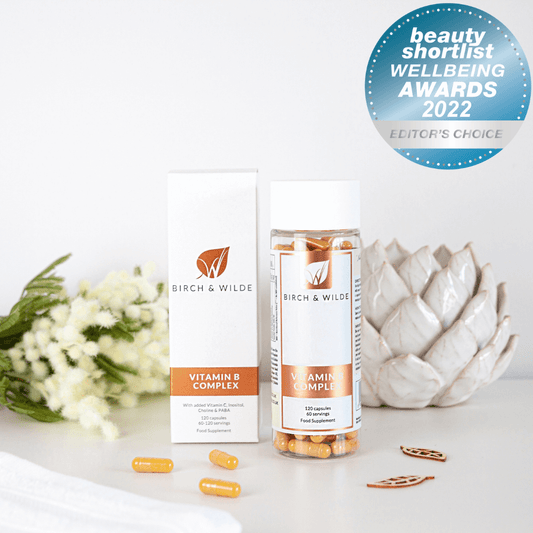
The Vitamin B Complex supports the nervous system, energy metabolism, and mood regulation that make showing up for your own life feel possible rather than exhausting. For the woman who has been running on insufficient reserves for longer than she realises, this is where nutritional support matters most.
Neither of these products is a statement about the global campaign we have been discussing today. They are simply what we make, offered to you in the spirit of a day that is asking every woman to take her own health seriously. Consider them, or do not. But do not dismiss them because you are not sure you are worth the bother.
You are. That has never been in question.
What to do with this today
Read the 2026 Call to Action at may28.org if you have not already. Share it with someone who should read it. Support the organisations doing the hard, essential, underfunded work of making women's health a global priority.
And then, in your own life, do one concrete thing today that treats your health as essential rather than optional. Book the appointment. Take the supplement you have been meaning to take consistently. Rest without justifying it. Pay attention to something your body has been trying to tell you.
The global and the personal are not separate. Every woman who decides that her own health is non-negotiable is, in her own way, advancing the same argument that 100 organisations across four continents came together to make this May 28th.
Essential. Not optional.
Not for any woman, anywhere.
Sources
Women's Global Network for Reproductive Rights. 2026 May 28 Call to Action: Essential, Not Optional. may28.org/2026-call-to-action
World Health Organization. Trends in Maternal Mortality 2000 to 2023. WHO, 2025. who.int
Women's Global Network for Reproductive Rights. About May 28. may28.org/about